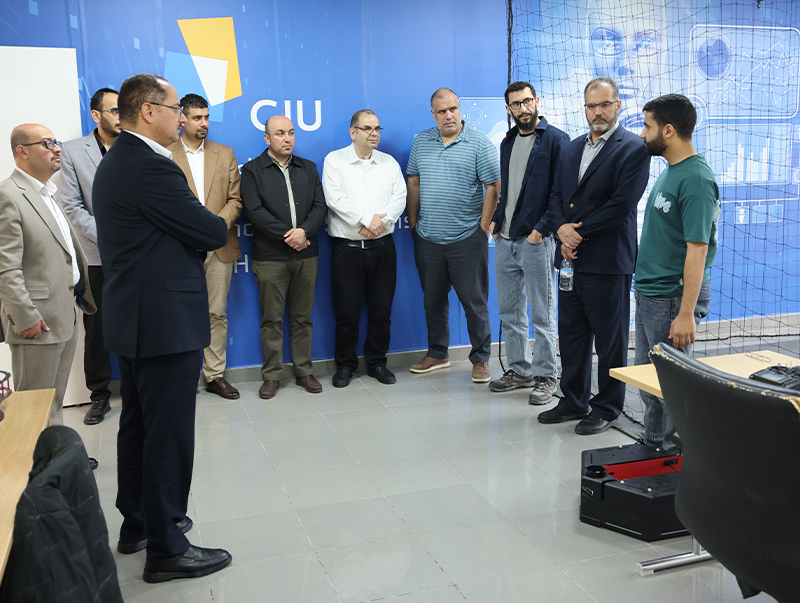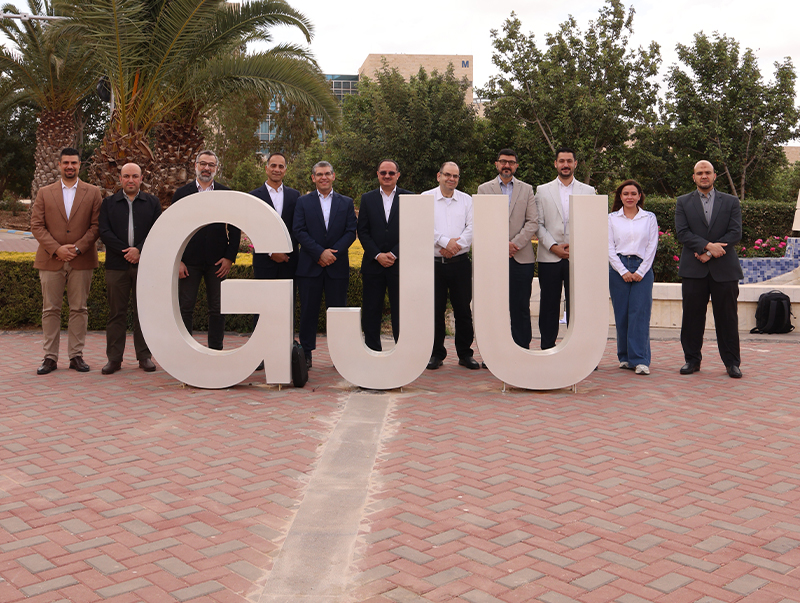

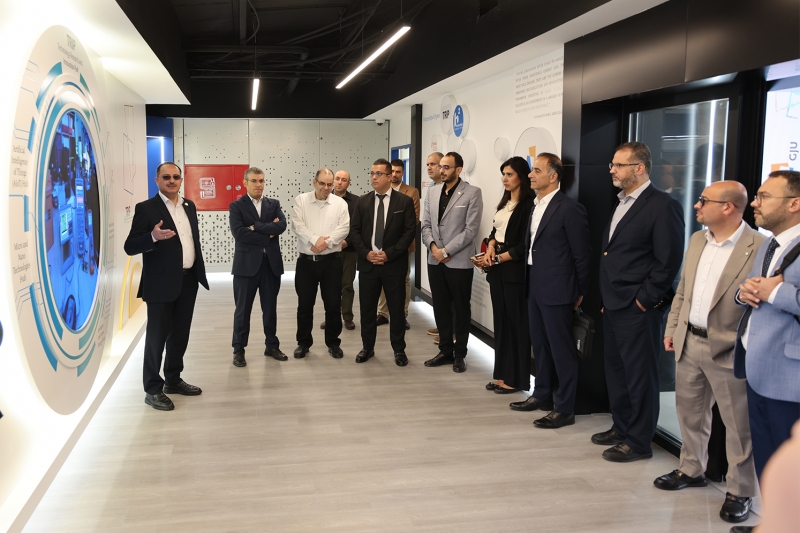
 As part of the German Jordanian University’s (GJU) commitment to direct engagement with its academic and administrative staff and to fostering a collaborative work environment, Prof. Ala’aldeen Al-Halhouli, President of the University, met with the faculty and staff of the School of Applied Technical Sciences and the School of Sustainable Systems Engineering. The meeting was attended by Prof. Aiman Al-Share, Dean of the Two Schools, along with academic and administrative personnel. The gathering was part of a series of regular meetings held by the University President with various schools across the university.
Prof. Al-Halhouli emphasized the importance of keeping pace with rapid developments in technology and applied engineering through continuous curriculum development and the modernization of teaching and learning methodologies. He noted that such efforts enhance students’ readiness for future challenges and equip them with the practical skills and expertise needed to compete in local, regional, and international labor markets.
He also stressed the importance of expanding research and applied collaborations with industrial and academic institutions, as well as strengthening partnerships that contribute to joint projects and the development of innovative solutions to emerging challenges, thereby reinforcing the university’s role in community service and sustainable development.
Furthermore, Prof. Al-Halhouli reaffirmed the university’s commitment to providing an academic and research environment that fosters creativity and excellence, while promoting a culture of integration and collaboration among its various units. Such efforts contribute to enhancing educational and research outcomes and strengthening the university’s distinguished standing at both the national and international levels.
He highlighted the pivotal role played by the Deanship of Innovation, Technology Transfer and Entrepreneurship (DI-TECH) and the Technology, Research and Innovation Park (TRIP) in advancing the university’s innovation ecosystem and transforming research outputs into practical applications and entrepreneurial projects with economic and societal impact. He also underscored their role in supporting researchers and students and enabling them to develop innovative ideas and solutions that address developmental challenges and contribute to a knowledge-based economy.
For his part, Prof. Aiman Al-Share expressed appreciation for the university leadership’s commitment to maintaining direct communication with the schools, noting that this approach reflects a spirit of partnership and institutional integration. He added that such engagement supports ongoing development efforts and enhances both educational and research processes in line with the university’s vision and strategic objectives.
The meeting featured an open discussion on a range of academic and administrative issues, as well as ways to further develop academic programs, strengthen a university environment that supports excellence and innovation, and deepen integration among schools, centers, and specialized deanships in line with the requirements of the Fourth Industrial Revolution and contemporary global trends.
These meetings are part of the German Jordanian University’s ongoing efforts to promote a culture of dialogue and participation, strengthen direct communication with its academic and administrative community, enhance institutional performance, and achieve its future aspirations while consolidating its position as a leading university in applied education, scientific research, innovation, and entrepreneurship.