

Laboratories

Course Description

Course Description
1 Credit hour (3 hrs laboratory)
Software experiments illustrating the basic principles and techniques of digital signal processing in order to process and analyse different physiological signals. Topics covered include

Course Description
1 Credit hour (3 hrs laboratory)

Course Description
1 Credit hour (3 hrs laboratory)
The aim is to the study of the movement of living things using the science of mechanics, also it is concerned with the description of motion and how forces create motion

Course Description

Course Description
1 Credit hour (3 hrs laboratory)
Introduce the concepts learned in the course through practical experiments using software application such as Matlab and Simulink. Topics covered include basics of different mathematical

Course Description
1 Credit hour (3 hrs laboratory)
Topics covered include building instrumentation amplifiers to compare it with the single chip, optocoupler working principle and its importance in biomedical field, operation, designing,

Course Description
1 Credit hour (3 hrs laboratory)
The aim of this lab is to gain insight into working of
Objective:
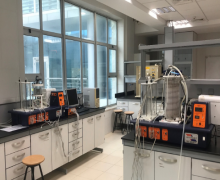
the laboratory of fluid dynamics,heat transfer , and chemical reaction engineering is a process material that relates to the theories covered by the materials of heat transfer engineering and chemical reactions. Upon successful

Objective: -To get practical knowledge of current laboratory techniques used in organic chemistry (Melting point determination, Different types of Distillation, Recrystallization, Extraction, Chromatography).
- To be

Objective: The practical part is designed to achieve a working knowledge through examination of some of the basic physicochemical principles covered in the lectures of PCE242 in the delivery of drug and the design of pharmaceutical dosage forms.
Syllabus

Objective: The main objectives of the course are to:
• Provide the knowledge of the “compounding art”, i.e. the art of preparing various Liquid & Semi-solid dosage forms, usually made in a pharmacy (community or hospital)
• Review the contents and objectives

Course Description
1 Credit hour (3 hrs laboratory)
Introduce the concepts learned in the course through practical experiments using software application such as Matlab and Simulink. Topics covered include basics of different mathematical

Objective: The main objectives of the course are to:
- To be able to conduct pre-formulation studies: Flowability, Solubility and Solubilization.
- To recognize the manufacturing process and formulation of solid dosage forms.

Objective: Separation Processes Laboratory is a practical course that is related to theories covered in separation processes course. Upon successful completion of this course, the student will be able to:
- Applying Separation concepts, heat and mass transfer

Objectives:
Instrumental Analysis is a science and an art! An unknown compound could be analyzed by more than one technique, simply because that chemical may have different properties. Instrumental Analysis Lab is considered as an advanced lab; the PCE students have to

Objective: The main objective of this course is to teach the students fundamental approaches for experimentally investigating biochemical problems, teach them the theoretical foundations for the used methods, and help them to understand the applicability of the biochemical

Objective:
The goal of this lab is to help the students to understand the fundamental principles of chemistry through performing simple experiments. These principles include physical separation techniques, different types of chemical reactions, Stoichiometry, volumetric

Objectives:
Analytical Chemistry is about studying types and quantities of unknown useful compounds like the key ingredients in food, drugs, cosmetics, and other consumables we usually deal with on daily basis. The analysis is performed practically in Analytical Chemistry

Objective: Aspen plus lab is the practical part of the pharmaceutical plant design course. In this lab, the student can do a simulation for the entire lifecycle of a process covering the following levels of details: conceptual engineering, basic engineering, detailed engineering

Course Description
1 Credit hour (3 hrs laboratory)
© 2014 - 2026, German Jordanian University, All rights reserved.