

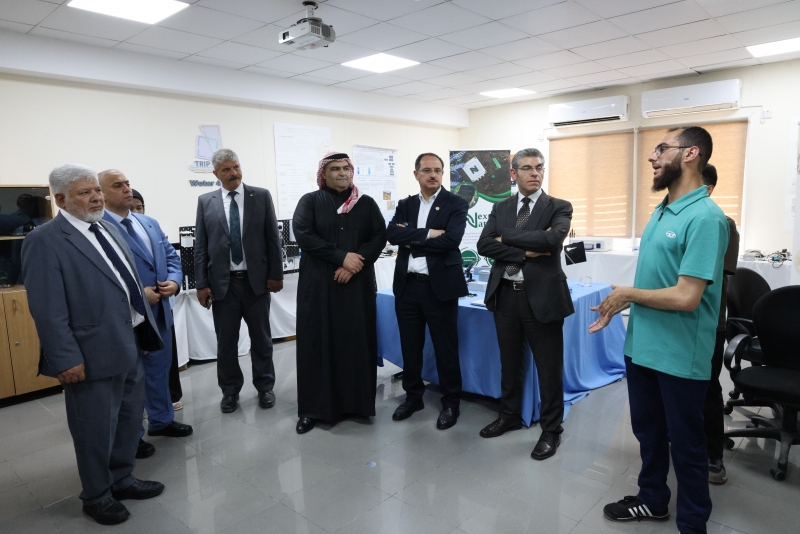
The Parliamentary Committee on Digital Economy and Entrepreneurship, chaired by MP Dr. Muayad Al-Alawneh, praised the advanced level reached by German Jordanian University (GJU) in the fields of digital transformation, applied education, and innovation. The Committee highlighted the university’s academic and technological achievements, which have strengthened its position as one of the leading higher education institutions in Jordan and the region.
This came during the Committee’s visit on Wednesday to the university, where members met with GJU President Prof. Ala’aldeen Al-Halhouli, in the presence of Vice President for Academic Excellence Prof. Iyas Khader, along with several specialists. The visit aimed to review digital transformation programs and modern technical specializations, and to explore avenues for enhancing cooperation between academic institutions and stakeholders in the digital economy and entrepreneurship sector.
MP Al-Alawneh stated that GJU represents a pioneering model in applied education, combining high-quality academic instruction with practical training under the German model. This approach contributes to preparing qualified graduates equipped with the skills and expertise required by the labor market. He also commended the university’s tangible progress in technology, digital transformation, and innovation, as well as its distinguished academic reputation locally and internationally.
He further noted that the university has consolidated its position as one of the leading higher education institutions in the Kingdom, thanks to its educational model that integrates academic excellence, practical application, and international partnerships. This has made it a successful model in producing graduates capable of competing locally, regionally, and globally, while contributing to national economic development.
Al-Alawneh added that digital transformation is no longer limited to automation or the development of electronic systems and digital services in the traditional sense. Rather, it now entails a cognitive and cultural shift among students and youth, enabling them to adapt to technological changes, anticipate future professions, and create new job opportunities aligned with both local and global labor market needs.
Members of Parliament Hamed Al-Rahamna, Raed Al-Qatamin, and Eyad Jibreen also praised the advanced standing of GJU and its achievements in academia, research, and technology, which have positioned it among the leading universities in the Kingdom and the region. They emphasized the importance of supporting universities that invest in technology, innovation, and scientific research.
They affirmed that Jordanian universities serve as key partners in implementing the Economic Modernization Vision and building an advanced digital economy, by preparing qualified national talent equipped with the skills needed for competitiveness and innovation across various sectors.
For his part, University President Prof. Ala’aldeen Al-Halhouli affirmed that GJU continues to develop its academic and research programs in line with national strategies for economic modernization and digital transformation.
He presented key university indicators, noting that the university hosts around 6,000 students, in addition to approximately 700 students currently studying or training in Germany under the university’s “Germany Year” programs. He emphasized that this experience plays a vital role in refining students’ skills and enhancing their readiness for the global labor market.
He further noted that the university has achieved a fully integrated digital transformation across its academic and administrative operations, implementing modern systems based on the latest digital technologies. This has improved operational efficiency and enhanced the quality of services provided to students, faculty, and administrative staff.
Al-Halhouli added that the university continuously monitors global market demands and rapid technological developments, working to identify future skills and knowledge requirements and integrate them into academic plans and curricula. He explained that academic programs are reviewed periodically every five years to ensure alignment with the latest scientific and technological advancements.
He concluded that the university adopts an educational philosophy based on innovation, applied learning, scientific research, and entrepreneurship, aiming to graduate students equipped with future-ready skills capable of competing regionally and globally, and contributing to national economic development.
During the visit, deans and center directors provided a detailed presentation on the university’s digital transformation over recent years, which included the development of faculties and academic departments, smart classrooms, academic programs, digital learning content, administrative systems, student services, and cybersecurity frameworks. They also highlighted significant financial, administrative, and time efficiencies achieved through these transformation initiatives.
The Committee also toured several laboratories, research centers, and modern technical facilities, including the university library, the Industry 4.0 Lab, and the Orange Fabrication Lab (SATS), as well as the Technology, Research, Innovation Complex and the Deanship of Innovation, Technology Transfer, and Entrepreneurship. They were briefed on key digital projects and innovative initiatives in artificial intelligence, cybersecurity, digital transformation, and advanced technologies.