

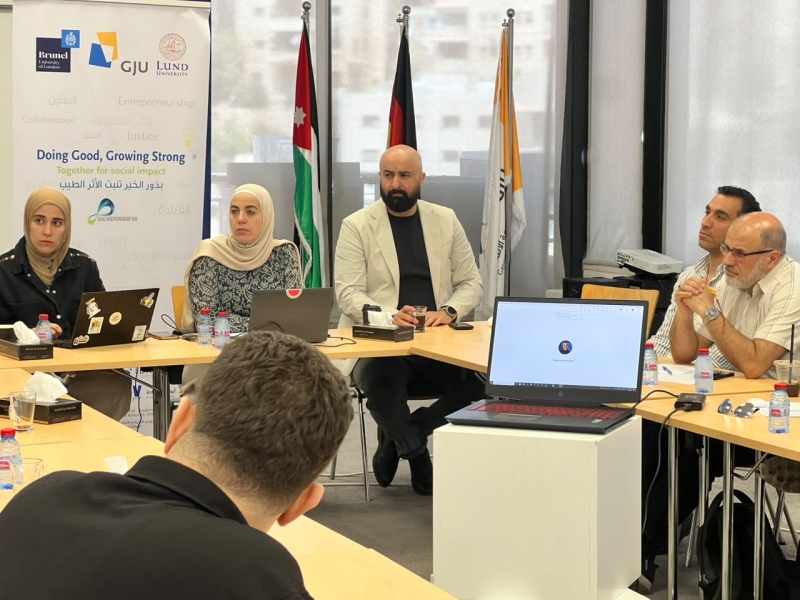
 As part of the “Doing Good, Growing Strong” project, implemented by the German Jordanian University (GJU) in partnership with Brunel University London, the project team organized a focus group discussion titled “Beyond Profit: The Reality of the Foundations of a Moral Economy in Jordan,” aimed at exploring the ethical values and principles influencing business practices and decision-making processes among businesses and entrepreneurs in Jordan.
The session was led by the project team, headed by Dr. Farah Al-Taji, Principal Investigator from Brunel University London; Dr. Abdelrahman Zuraik, Co-Investigator and Project Manager at GJU; and Arch. Dana Al-Lafi, Project Coordinator at GJU. The research is conducted by Ghufran Abudayyeh, Independent Researcher, and Dr. Farah Al-Taji.
The focus group forms part of an inductive research study that seeks to understand the ethical frameworks and values shaping the practices of businesses and entrepreneurs in Jordan. It provided participants with an opportunity to reflect on their lived experiences and explore how values such as trust (amānah), sincerity, excellence (iḥsān), well-being (falāḥ), and community benefit influence contemporary business practices and decision-making.
The session also examined the drivers behind everyday commercial transactions and the relationship between ethical principles and material interests. Drawing on contemporary Islamic thought and emerging approaches to moral economy, the discussion explored how ethical values can inform the development of more just and responsible economic frameworks through five exploratory themes, including Identity and Work Culture, Excellence (Iḥsān) and Decision-Making, relationships among stakeholders, businesses, and local communities, and approaches to balancing ethical considerations with material interests.
The discussion also focused on Trusteeship (I'timāniyya) and Ownership, including concepts related to ownership, control, and responsibility over resources, as well as Self-Purification (Tazkiya) and the Business Ecosystem, examining the extent to which existing economic systems support or challenge ethical business practices. It also explored Well-being (Falāḥ) and Success, focusing on how success, well-being, and progress are defined in business and economic contexts, contributing to an open and exploratory dialogue grounded in participants’ experiences and perspectives.
Through this research, the project aims to deepen understanding of the relationship between ethical values, entrepreneurship, and economic practices in Jordan, while exploring the potential for developing alternative approaches toward a more just, values-driven economy grounded in social responsibility. The insights and experiences shared by participants are expected to contribute to broader research examining the foundations and practical dimensions of a moral economy in Jordan.